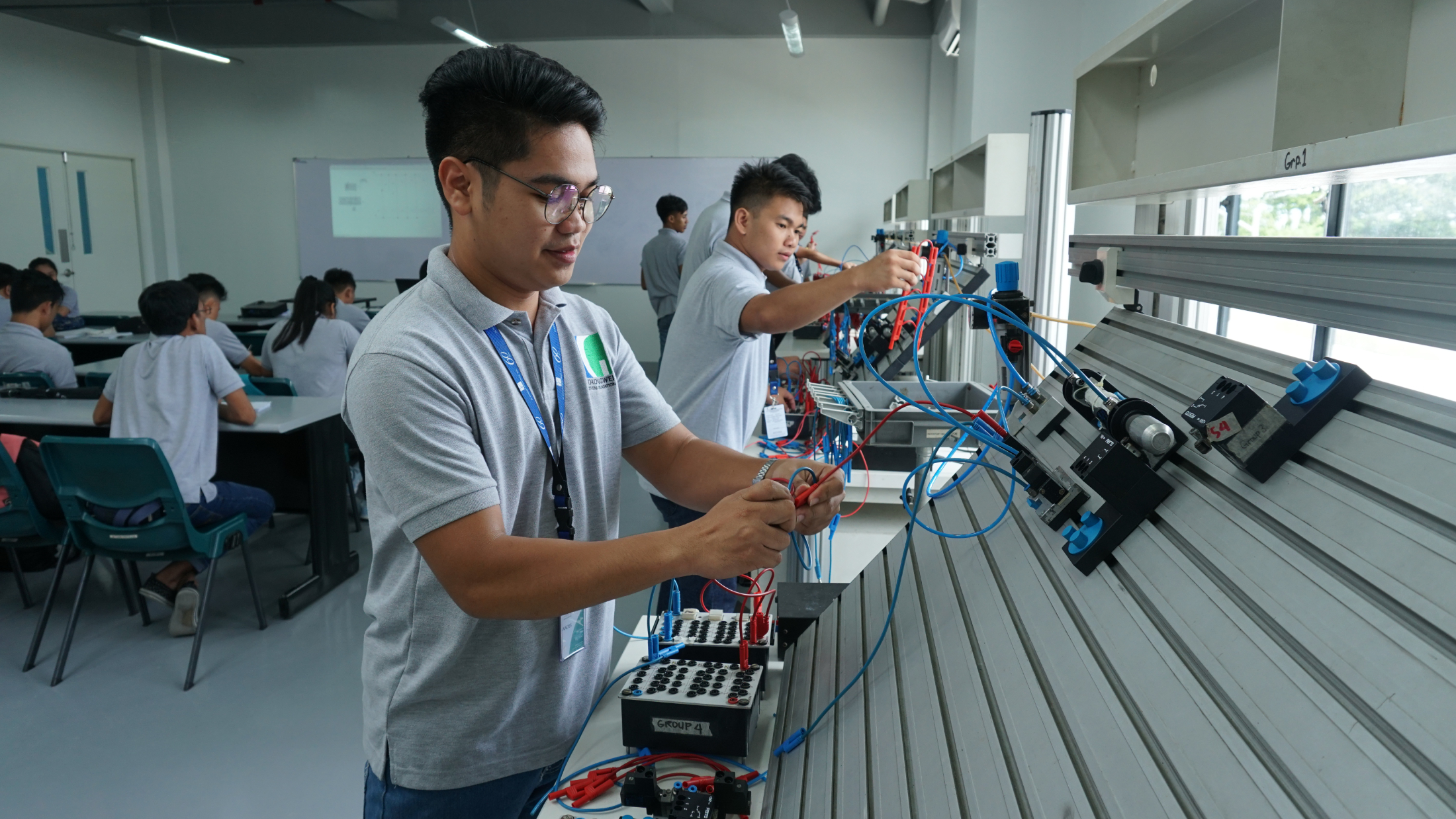
Technical short courses are offered to employees of manufacturing companies to enhance their technical training skills. These courses were carefully reviewed to ensure they meet the learning needs of the employees-in-training.
This module deals with the study of the electrical equipment, apparatus, component, device s and instrument. The study focuses in the functions, operations, construction, characteristic, specification and some of its applications. Selections and the proper use of hand tools, testing instruments and electrical safety is also emphasize.
This module deals with the study of the electrical equipment, components, devices and materials and its specification standard. The study focuses in the usage and application of electrical parts and also the functions, operations, construction and characteristics. Selections requirements based on standard and electrical safety is also emphasized.
This course introduces the participants to the world of variable frequency drives and will be most helpful to workers in industrial plants and commercial buildings. Participants will learn how to improve VFD control and efficiency, troubleshoot and fix VFDs, reduce equipment downtime, eliminate chronic VFD problems, lower the cost of VFD operation, and alleviate the need for hiring costly outside service contractors, all while establishing a culture of safe work practices among employees.
This course provides flexible and skills-based training in basic electronics. It has been developed for adult learners pursuing basic technician level training. The program was developed to address the need for technicians to analyze problems in electronic circuits and perform the correct method in troubleshooting and repair at the shortest possible time that is needed in rapidly-growing industry. Topics in Passive Components, Active Components, and Digital Electronics are covered.
The training program is designed and intended for all experienced technicians, building shift engineers and building management professionals who want to improve their knowledge and skill on the art of science of refrigeration and air conditioning. This HVAC Program curriculum consists of comprehensive lessons that cover essential HVAC/R theory, typical HVAC systems and components used in residential and commercial buildings, as well as standard procedures for installing, troubleshooting and maintaining HVAC/R installations and commercial refrigerationWorkshop exercises are being carried out through the course of training in order to acquire actual and practical hands on experiences in the operation and routine maintenance of different instruments and controls applied in RAC system.
This trade subject covers the identification, proper handling and awareness of problems concerning common Process Automation and Instrumentation (PAI) equipment and systems. Only a few fundamental control systems are presented to determine the typical location of common devices in the system. Workshop practice consist mainly with familiarization of components, visual inspection, correct taking of data, proper care and operation with these equipment & systems. The relevance of ISO Standards to Industrial Instrumentation is briefly introduced.
This trade subject covers the operation, functional testing and troubleshooting of Process Automation and Instrumentation (PAI) instruments and systems. Workshop practice focuses on the calibration of common PAI for the measurement and control of the four (4) fundamental Process Variables, namely: Pressure, Level, Flow and Temperature. The skill in recording and interpreting calibration data is also given emphasis. The operation, configuration and tuning fundamentals of common PID process controllers are covered.
This trade subject covers the specification, fundamental tests and proper handling of common Process Automation and Instrumentation (PAI) equipment and systems. The most fundamental process control systems are presented to demonstrate the typical applications of common devices in the system. Workshop activities consist mainly with familiarization of components, visual inspection and correct taking of specifications. The relevance of ISA and ISO Standards to Industrial Instrumentation is briefly introduced
The course deals with the study of the different industrial mechanical tools, elements and drive systems inclusive of their functions, operations and applications. It also includes training on the detection of abnormalities and manifestation of troubles during operation, preparing necessary reports, parts lubrication and routine preventive maintenance.
The course deals with the study of different physical laws of hydraulics, functions of different hydraulic components and basic hydraulic circuits used in operating hydraulic controlled equipment. Topics include hydraulic power pack components covering their functions and principle of operations, different directional control and non-return valves as applied incontrolling movement of working elements and discussion on topics in pressure and speed control circuits. The course presents the different hydraulic symbols and explains how they are used in schematic diagrams according to the ISO standard. Sufficient time is allocated for hands-on exercises to achieve hook-up skill and observe safety practices.
The course aims to teach the participants the concepts of pneumatics, and the different components of pneumatics, their functions, operations, & applications. It also aims to teach them to detect abnormalities, make necessary reports and perform routine preventive maintenance activities.This course also deals with the development of knowledge and skills in operating basic automation circuits in industrial pneumatic controlled equipment. It includes both the physical principles and basic control applications of industrial pneumatics. Sufficient time is allocated for practical exercises.
This course covers the operating principles of the commonly used proximity sensors for machine automation namely: mechanical limit switches, reed switches, inductive sensors, capacitive sensors, and photoelectric sensors. The course also deals with the advantages, disadvantages, and applications of these proximity sensors.
This course covers the operation, application, basic troubleshooting procedure, basic preventive maintenance, basic capabilities, functional features and specification of PLC’s. Emphasis is on operation, testing and simulation of various practical circuits using Seimens S71200 PLC
This 1-day program is designed to equip subject matter experts with the essential skills and knowledge to effectively design and deliver high-impact training programs. Participants will gain a deep understanding of adult learning principles, instructional design methodologies, and effective facilitation techniques. Through a combination lectures, demonstration, discussion, and practical application, participants will develop the confidence and competence to become skilled trainers and mentors.
The course aims to understand fundamental operation of boilers in order to improve efficiencies and safety at their industrial plants and large building facilities. It also aims to learn the differences and similarities of different types of boiler and also gain knowledge of the functions of the water tube boiler components to include the steam and water side of the boiler as well as the fuel and air side of the boiler.
Pumps and compressor are essential components in almost all industries in that they are required to meet system demands and operate reliability. In these regard the course is so design in order to meet challenges in solving problems related to pumps and compressor. By attending this course you will gain an understanding of the characteristics of various types of pumps and compressors and their components. The course will provide Engineers and Technicians with information for the optimal selection, operation and maintenance of centrifugal and positive displacement pumps as well as positive displacement and dynamic compressors. Workshop exercises are being carried out through the course of training in order to acquire actual and practical hands on experiences in the operation and routine maintenance of pumps and compressors
The course deals with the study of different physical laws of hydraulics, functions of different hydraulic components and basic hydraulic circuits used in operating hydraulic controlled equipment. Topics include hydraulic power pack components covering their functions and principle of operations, different directional control and non-return valves as applied incontrolling movement of working elements and discussion on topics in pressure and speed control circuits. The course presents the different hydraulic symbols and explains how they are used in schematic diagrams according to the ISO standard. Sufficient time is allocated for hands-on exercises to achieve hook-up skill and observe safety practices.
The course aims to teach the participants the concepts of pneumatics, and the different components of pneumatics, their functions, operations, & applications. It also aims to teach them to detect abnormalities, make necessary reports and perform routine preventive maintenance activities.This course also deals with the development of knowledge and skills in operating basic automation circuits in industrial pneumatic controlled equipment. It includes both the physical principles and basic control applications of industrial pneumatics. Sufficient time is allocated for practical exercises.
This course covers the operating principles of the commonly used proximity sensors for machine automation namely: mechanical limit switches, reed switches, inductive sensors, capacitive sensors, and photoelectric sensors. The course also deals with the advantages, disadvantages, and applications of these proximity sensors.
This course covers the operation, application, basic troubleshooting procedure, basic preventive maintenance, basic capabilities, functional features and specification of PLC’s. Emphasis is on operation, testing and simulation of various practical circuits using Seimens S71200 PLC
This 1-day program is designed to equip subject matter experts with the essential skills and knowledge to effectively design and deliver high-impact training programs. Participants will gain a deep understanding of adult learning principles, instructional design methodologies, and effective facilitation techniques. Through a combination lectures, demonstration, discussion, and practical application, participants will develop the confidence and competence to become skilled trainers and mentors.
The course aims to understand fundamental operation of boilers in order to improve efficiencies and safety at their industrial plants and large building facilities. It also aims to learn the differences and similarities of different types of boiler and also gain knowledge of the functions of the water tube boiler components to include the steam and water side of the boiler as well as the fuel and air side of the boiler.
Pumps and compressor are essential components in almost all industries in that they are required to meet system demands and operate reliability. In these regard the course is so design in order to meet challenges in solving problems related to pumps and compressor. By attending this course you will gain an understanding of the characteristics of various types of pumps and compressors and their components. The course will provide Engineers and Technicians with information for the optimal selection, operation and maintenance of centrifugal and positive displacement pumps as well as positive displacement and dynamic compressors. Workshop exercises are being carried out through the course of training in order to acquire actual and practical hands on experiences in the operation and routine maintenance of pumps and compressors
The Basic Handy Man Skills Training Level 1 Program provides introductory technical knowledge and basic practical skills in addressing commonly encountered household maintenance, installation, and repair concerns. The program covers fundamental competencies in Basic Electrical Wiring and Installation, Basic Plumbing, and the proper use of commonly used Power Tools. It includes Electrical Materials Identification and Wiring Installation, covering the selection, handling, and installation of common electrical components and wiring devices in accordance with basic electrical standards and safety practices. The program also includes familiarization with various Power Tools, focusing on proper operation, handling procedures, and safe usage practices. In addition, participants will be introduced to Basic Plumbing principles, including the installation, repair, and maintenance of common household plumbing fixtures and piping systems. The training is designed to provide basic familiarization with the uses of common materials and tools, and to develop introductory practical skills in performing basic installation, maintenance, and repair works applicable to residential and workplace environments. The program also aims to help participants better understand commonly used household products, materials, and tools to effectively assist customers and address basic technical concerns.
The program is designed as a training intervention to address two major concerns on human resource development. First, to fill the present gap in the training competencies of technicians and engineers in the production shop floors who at the same time are conducting training activities to on-the-job/in-plant trainees, new hires or even to peers within the company. Second, to ensure the improvement in the knowledge, skills, values and attitude of workers and that the training costs do not go to waste and the identified problem areas are appropriately addressed.
This course provides participants with the knowledge and practical skills required to identify, analyze, troubleshoot, and repair electronic printed circuit boards (PCBs). The training focuses on component identification (Through – hole and Surface Mount Technology), circuit analysis, fault isolation techniques, use of electronic test instruments, interpretation of schematics, and best practices in board-level repair and preventive maintenance. Upon completion, participants will be able to safely diagnose common electronic failures, identify defective components, utilize appropriate troubleshooting equipment, and perform corrective actions to restore PCB functionality.